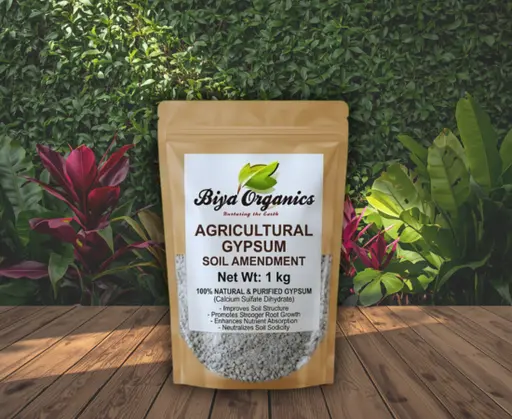
Agricultural Gypsum
Agricultural Gypsum
Agricultural gypsum is calcium sulfate. It supplies calcium and sulfur, and in certain sodic or clay soil situations it can help improve soil physical condition. It is not the same as lime and does not meaningfully raise soil pH.
Product Overview
• Product Name: Agricultural Gypsum
• Category: Soil Conditioners and Growing Media
• Product Type: Calcium sulfate soil amendment
• Form / Texture: White to off-white powder or granules
• Suitable For: Soils needing calcium and sulfur, sodic soil management, and clay-structure support where appropriate
• Application: Soil application based on soil test and local recommendation
Why Agricultural Gypsum Is Useful
• Provides calcium without the strong pH-raising effect of lime.
• Provides sulfur for plant nutrition.
• Can help with specific soil structure problems where sodium is an issue.
• Useful when soil test indicates a need.
Main Components
• Calcium sulfate dihydrate. • Calcium. • Sulfur in sulfate form. • Minor impurities depending on source.
Benefits
• Adds calcium for root and cell wall development.
• Supplies sulfur for protein and enzyme functions.
• May improve sodic soil behavior when paired with leaching.
• Does not replace lime for acidic soil correction.
Growing and Application Requirements
• Use based on soil test or clear soil problem.
• Do not expect gypsum to raise pH like agricultural lime.
• Water is needed to move dissolved calcium into the soil profile.
• Avoid unnecessary repeated use in balanced soils.
Usage Instructions
• Broadcast evenly over soil.
• Lightly incorporate where practical.
• Irrigate after application.
• Follow local agricultural rates for field use.
Common Uses
• Sodic soil management
• Calcium supply
• Sulfur supply
• Clay soil conditioning
• Field crops
Advantages
• Supplies calcium without liming strongly.
• Useful for some soil structure issues.
• Generally easy to spread.
Disadvantages or Limitations
• Does not correct acidic soil pH.
• Will not magically loosen every clay soil.
• Unneeded use wastes money and may disturb nutrient balance.
Maintenance and Storage Tips
• Use a soil test before applying large amounts.
• Combine with organic matter for better long-term soil structure.
• Store dry to prevent clumping.
Safety and Precautions
• Avoid inhaling dust.
• Use eye protection while spreading.
• Keep bags away from moisture.
Best Plants or Situations
• Field crops • Lawns • Clay soils with sodium issues • Orchards where soil tests support use
Useful Facts
• Gypsum is calcium sulfate, while lime is mainly calcium carbonate.
• The difference matters because carbonate is what neutralizes acidity.
Summary
Agricultural gypsum is a targeted soil amendment, not a universal soil fixer. It is valuable when calcium, sulfur, or sodic soil correction is truly needed.
References Consulted
• University of Minnesota Extension - Liming materials and gypsum note: https://extension.umn.edu/node/7731
• Oregon State University Extension - The ABCs of NPK: https://extension.oregonstate.edu/catalog/em-9691-abcs-npk-fertilizer-guide