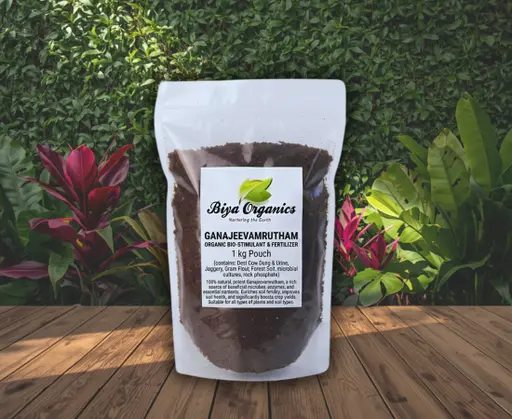
Ganajeevamrutham
Ghanajeevamrutham
Ghanajeevamrutham, often written as Ghana Jeevamrutham or Ghanajeevamrutham, is the solid form of Jeevamrutham used in natural farming. It is prepared from cow dung, cow urine, jaggery, pulse flour, and a little native soil, then fermented into a microbe-rich organic input.
Product Overview
• Product Name: Ganajeevamrutham
• Category: Organic Fertilizers and Natural Farming Inputs
• Product Type: Solid fermented microbial manure used in natural farming
• Form / Texture: Moist to dry crumbly organic mixture, usually prepared from cow dung-based ingredients
• Suitable For: Vegetables, field crops, fruit plants, kitchen gardens, and soil microbial activation
• Application: Basal soil application, top dressing, or compost-style soil enrichment
Why Ganajeevamrutham Is Useful
• Acts as a solid microbial inoculant for the soil.
• Adds small amounts of organic nutrients along with beneficial microbial activity
. • Useful where liquid Jeevamrutham is difficult to transport or apply.
• Fits into composting, mulching, and natural farming systems.
Main Components
• Desi cow dung and cow urine in traditional recipes
• Jaggery as an energy source for microbes.
• Pulse flour or besan as a protein and nitrogen support.
• A handful of native farm soil as microbial starter.
Benefits
• Improves microbial activity in the root zone.
• Supports gradual nutrient release as it decomposes.
• Helps maintain living soil when used with mulch and organic matter.
• Easy to place near plants compared with liquid preparations.
Growing and Application Requirements
• Use well-fermented material, not raw wet mixture.
• Keep the preparation shaded and aerated during fermentation.
• Apply with moisture in the soil so microbes can become active.
• Use along with compost or mulch for better results.
Usage Instructions
• Apply a small quantity near the root zone and cover lightly with soil or mulch.
• Use during bed preparation or around established plants.
• Water gently after application.
• Repeat periodically according to crop need and local natural farming practice.
Common Uses
• Natural farming soil activation.
• Vegetable beds. • Fruit tree basins. • Compost enrichment. • Field crop basal application.
Advantages
• Low-cost farm-made input.
• Easier to store and transport than liquid Jeevamrutham.
• Supports soil biology and organic matter cycling.
Disadvantages or Limitations
• Nutrient content is variable and not as precise as a labeled fertilizer
. • Poor fermentation can cause odor or attract flies.
• Needs organic matter and moisture in the soil to show good effect.
Maintenance and Storage Tips
• Prepare under shade and avoid plastic bags that trap foul anaerobic moisture.
• Break lumps before application.
• Use with mulching so soil microbes have food and protection.
Safety and Precautions
• Wear gloves while preparing and applying.
• Wash hands after handling cow dung-based inputs.
• Keep away from drinking water, food preparation areas, children, and pets.
Best Plants
• Vegetable beds • Fruit trees • Field crops • Banana • Kitchen gardens • Mulched beds
Useful Facts
• Ghana means solid or dense, which is why it is considered the solid counterpart of Jeevamrutham.
• It is valued more as a microbial and soil-life input than as a high-analysis fertilizer.
Summary
Ganajeevamrutham is a solid natural farming input for activating soil life and supporting slow organic nutrition. It works best in moist, mulched, biologically active soil.
References Consulted
• Tamil Nadu Agricultural University - State of organic farming in Tamil Nadu: https://agritech.tnau.ac.in/org_fa rm/pdf/State%20of%20Organic%20Farming%20in%20Tamil%20Nadu%20-%20KSS%202026%20Final.pdf
• Tamil Nadu Agricultural University - Biofertilizers technology: https://www.agritech.tnau.ac.in/org_farm/orgfarm_biofertilizertechnology.html
• University of Minnesota Extension - Soil biology: https://extension.umn.edu/soil-management-and-health/soil-biology