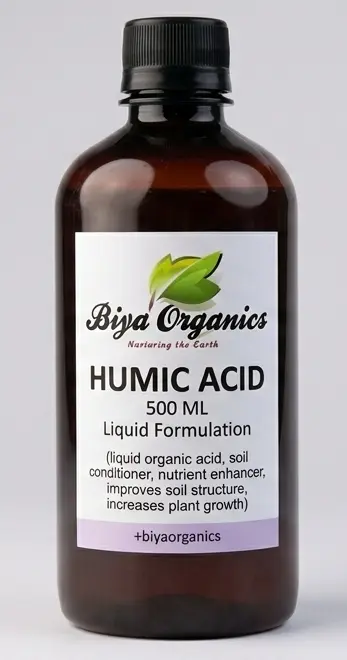
Humic Acid 500 ML
Humic Acid
Humic acid products contain humic substances derived from organic matter sources such as leonardite, compost, or humate deposits. They are best understood as soil conditioners and nutrient-efficiency helpers, not complete fertilizers.
Product Overview
• Product Name: Humic Acid
• Category: Nutrients and Plant Supplements
• Product Type: Humic substance soil conditioner and biostimulant
• Form / Texture: Liquid concentrate, soluble powder, or granules depending on product
• Suitable For: Soils with low organic matter, container plants, lawns, orchards, and nutrient-efficiency programs
• Application: Soil drench, fertigation, foliar spray where labeled, or granular soil application
Why Humic Acid Is Useful
• Can improve nutrient availability and root-zone chemistry.
• Supports soil organic matter functions.
• Often used with fertilizers to improve efficiency.
• Useful in low-organic-matter or stressed growing conditions.
Main Components
• Humic acid and related humic substances.
• Fulvic acid in some products.
• Potassium humate or other salts depending on formulation.
• Carrier water or granule base.
Benefits
• Helps nutrients remain more available in the root zone.
• May support root growth and microbial activity.
• Can improve soil structure over repeated applications.
• Useful with micronutrient programs.
Growing and Application Requirements
• Use with a real nutrient program; humic acid is not complete plant food.
• Follow label rate because concentration varies widely.
• Apply to moist soil for best movement into the root zone.
• Check compatibility before tank mixing. Usage Instructions
• Dilute liquid products as directed.
• Drench around roots or apply through irrigation where allowed.
• Use during active growth or after transplanting.
• Repeat at label interval rather than overapplying.
Common Uses
• Soil conditioning • Root support • Fertilizer efficiency • Micronutrient availability • Stress recovery
Advantages
• Useful with many crops and ornamentals.
• Works well in soil-building programs.
• Can complement organic and synthetic fertilizers.
Disadvantages or Limitations
• Not a substitute for NPK or micronutrients.
• Product quality varies.
• Benefits may be subtle in already healthy soils.
Maintenance and Storage Tips
• Apply after watering or before light irrigation.
• Use lower rates in small pots.
• Store liquid products away from heat.
Safety and Precautions
• Avoid inhaling powders.
• Wear gloves because concentrates can stain.
• Keep container tightly closed.
Best Plants or Situations
• Lawns • Vegetables • Fruit trees • Potted plants • Low-organic-matter soils
Useful Facts
• Humic substances are part of natural soil organic matter.
• They influence nutrient holding and root-zone chemistry more than they directly feed like fertilizer salts.
Summary
Humic acid is a soil-support product that helps the plant environment work better. It is most useful when paired with compost, sensible fertilization, and healthy watering.
References Consulted
• HortScience - Humic and fulvic substances in horticulture: https://journals.ashs.org/downloadpdf/view/journals/hortsci/59/2/article-p235.pdf
• University of Minnesota Extension - Soil biology: https://extension.umn.edu/soil-management-and-health/soil-biology
• University of Maryland Extension - Garden fertilizer basics: https://extension.umd.edu/resource/garden-fertilizer-basics/